
If you continue browsing this website, you agree to our policies:
  • Site Policy
Continue
x
EUMETSAT
  • HOME
  • Calendar
  • COURSES & WORKSHOPS
    Atmospheric Composition Climate Monitoring Data Access Services Land Applications Machine Learning Ocean Applications Remote Sensing Weather Learning about Learning Cross-thematic Webinars
  • OPEN LEARNING
  • PARTNERS
  • More
Site-wide search Close
Toggle search input
English ‎(en)‎
English ‎(en)‎ Español - Internacional ‎(es)‎ Français ‎(fr)‎ Português - Brasil ‎(pt_br)‎ Português - Portugal ‎(pt)‎ Русский ‎(ru)‎ العربية ‎(ar)‎
You are currently using guest access
Log in
EUMETSAT
HOME Calendar COURSES & WORKSHOPS Collapse Expand
Atmospheric Composition Climate Monitoring Data Access Services Land Applications Machine Learning Ocean Applications Remote Sensing Weather Learning about Learning Cross-thematic Webinars
OPEN LEARNING PARTNERS
Expand all Collapse all
  1. CALMET 2012
  2. Assessment: Crafting Effective Multiple-choice Questions
  3. Question 02

Question 02

Completion requirements

Q 2.  What level of learning objectives does this question measure?

You are a TV meteorologist on a network 10 p.m. newscast in the Philadelphia PA area. Your main concern is the potential for snow during rush hour (7 a.m. to 9 a.m.) of the next morning.

At 5 p.m. your time, you reviewed the previous hour’s radars, surface observations, and corresponding forecasts of simulated composite radar reflectivity and lowest level reflectivity from the 18 UTC NAM/WRF-NMM run that day.
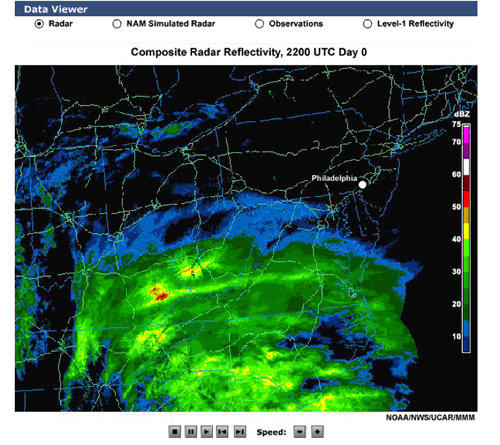
Data viewer of radar, simulated radar, observations, etc.


Given the data in these afternoon graphics, how would you assess the NAM forecast from 18 UTC valid at 21 and 22 UTC?  Choose all that apply.

a.  The composite radar reflectivity indicates that the NAM is too slow developing precipitation in eastern North Carolina (C)
b.  The composite radar reflectivity indicates that the NAM is too fast developing precipitation in south-central Virginia
c.  The observations indicate that the NAM is too slow developing precipitation in south-central Virginia. (C)
d.  The observations indicate that the NAM is correctly developing precipitation in south-central Virginia.  


Q 2.  What level of learning objectives does this question measure?

Confirm

Sorry, guests are not allowed to make choices.

Would you like to log in now with a full user account?

Show chart data

Quick links
  • About Us
  • Contact Us
  • Site Policy
© 2026 EUMETSAT
You are currently using guest access (Log in)
Data retention summary
Policies
Get the mobile app
Powered by Moodle